Showing posts with label Innertainment. Show all posts

Sunday, August 25, 2013

MicroBeatMini

Title: MicroBeatMini, the Ultimate All-in-One AudioStrobe Light & Sound Mind Machine
Author: Innovex
Format: Audiostrobe decoder / L&S Machine
Source: www.microbeatmini.com
Price: $299
Rating: good

The MicroBeatMini (mBm) is a fascinating innovation in the world of audio-visual stimulation machines. All other "mind machines" have consisted of goggles, headphones, and a box they plug into—the box being the brains of the operation, the part that allowed you to select various brainwave frequencies or programs to experience. As an add-on to the typical pre-loaded programs, most L&S machines can serve as AudioStrobe decoders, allowing them to take any AudioStrobe mp3 or CD signal introduced through an auxiliary port and output the necessary sound and light signals. (If you're not clear about what AudioStrobe is, you can read about it here.)

The mBm cuts out the middleman: rather than generating and storing its own BWE programs, it just serves as an AudioStrobe decoder, plain and simple. Here's how it works:

You play an AudioStrobe file on your computer, CD player, or mp3 player. (Be sure it's at 320 bit rate—the highest quality.) Instead of plugging in head phones or speakers, you plug in the MicroBeatMini. (It looks like a pair of space-age super goggles that would be at home on one of the X-men.) Then you plug in the head phones to the goggles. Thus, it's entirely an output device, but it's also a completely self-contained unit that you wear on your face.
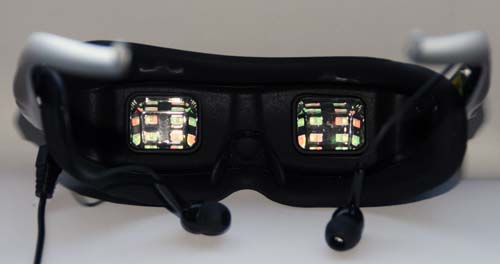
In keeping with that economy of design, all the controls are right there on the goggles: audio volume controls, a brightness button, and a "mode" button that switches the lighting between green, red, white, and any combination thereof. That's right—unlike the older photic goggles, which came in one color each, the mBm has a total of sixteen (16!) LEDs implanted in a mirrored, concave surface, for an unprecedented light show. So by dropping the pre-loaded content, mBm was able to really step up the quality of photic stimulation.

One of my favorite things about the mBm is the flexibility in the audio output. In keeping with its all-in-one theme, the mBm comes with a pair of discrete ear buds that can actually be stored in the goggles unit. No more fighting the inevitable cord tangle that comes with every other L&S machine I've ever used! For those who don't like ear buds, there is a head phone jack, and the mBm comes with a pair of light-duty Koss head phones that blow away the bargain basement head phones shipped with some mind machines. Of course, audiophiles might prefer even fancier headphones, like these.

Another nice accessory is the removable rubber shield that prevents bleed-over. As with the Laxman, this keeps the flashing lights from annoying my wife if I feel like using the MicroBeatMini in bed at night. For those who find the rubber a bit humid, the shield is easy to remove and re-install.

The MicroBeatMini runs on internal rechargeable batteries, much like an iPod; in fact it recharges with a USB cord that shares a port with the data input. It can take up to two hours to fully recharge. Having no on/off switch and no power saver mode, it loses power any time the input cord is attached. This arrangement has two disadvantages. First off, you can be either recharging it or using it; because both cords use the same port, it can't recharge while in use. Second, you can't store it with the input cord plugged in. Now, if you're a very organized person who always disassembles the unit and puts all of the cords back in the carrying case each time, that is not a problem. (By the way, the mBm comes with an excellent carrying case, complete with side pockets, that easily fits the unit, all the accessories, and the manual.) However, if you're like certain people I know who are genetically incapable of remembering to unplug a machine or stow the cords, this set-up is disastrous, especially when you consider that some of the necessary cords are not exactly available at your corner electronics store. So I'd say that aspect is my least favorite element of the mBm.

Although the mBm cannot come with any preset programming, the package does include a complimentary AudioStrobe sampler CD with some very enjoyable tracks. Now, if you rip that CD to mp3s, remember to do it at top quality (320 bit rate), or the photic signal won't come through, and you'll be wondering why the heck your machine isn't working. You'll also get a chance to discover, as I did, how polite and helpful the mBm customer service folks are.

Of course, the sampler CD is just the beginning. There are plenty of AudioStrobe recordings out there, and you can even get software to create your own (as I will discuss in upcoming reviews). There are also smart phone apps that will interact with your AudioStrobe device.

As a personal-use device, the MicroBeatMini is elegant and self-contained. Yes, it relies on an audio output device, such as a computer, phone, tablet, or CD/mp3 player, that must be purchased separately, but seriously, who doesn't have something like that these days?

As a device to use with clients, the mBm has a few minor most drawbacks, notably that it cannot charge while in use and must be disconnected while not in use. Fumbling with electronics during a session does not make the best impression on clients. On the other hand, operation during a session is simple—just hit play on your iPod.

My favorite use for the mBm is in conjunction with computer software packages such as Mind Workstation (which I will review in an upcoming post). It plugs right into the head phone jack on my PC, making it ideal for working software.


So, all-in-all, compact, efficient design combined with unprecedented photic quality make the MicroBeatMini a great product for the price.


FULL DISCLOSURE: The makers of MicroBeatMini were kind enough to provide me with a unit to review.

Sunday, August 18, 2013

Laxman Light & Sound Machine

Title: Laxman "Innertainment" System
Author: Neurotronics
Source: http://www.marksgs.com/ (in the U.S.)
Price: around $600 to $650
Rating: Excellent

The Laxman is the first of several L&S machines I'll be reviewing. Each one has its strengths and weaknesses. If you're unclear on what L&S machines do or what they are, please read this introduction.

The name of the Laxman is—I'm guessing here—a combination of "relax" and "walkman" (as in the original personal tape player, the predecessor of the iPod). In format, it's not unlike an over-sized iPod with goggles in addition to ear buds. Made in Germany, the chrome-and-white-plastic device has Apple-inspired styling; it is without a doubt the L&S machine most likely to be mistaken for a fashion accessory. This is a step forward aesthetically from the older mind machines, some of which look like Commodore computer accessories meant to withstand a plane crash and others of which resemble, well, um, a walkman straight out of 1985.

The goggles are also different from those of the past. Most mind machine goggles resemble cheap sunglasses with LEDs glued inside. The Laxman goggles, which rely on the Ganzfeld effect and can be used eyes-open or eyes-closed, resemble swim goggles, complete with a rubber shield. The great thing about this is there's no bleed over from the flashing lights to annoy your spouse in bed. In fact, the Laxman is pretty much the only L&S machine my wife has been willing to try out, so perhaps all that fancy styling is worth it, despite the fact that almost no one walks around wearing an brainwave tuner.

Ultimately, though, what matters most is how the machine works, and fortunately, the Laxman delivers a lot of functionality. It comes loaded with a number of ready-made sessions that are full-on experiences with beautiful lights in a whole rainbow of colors, bwe tones, nature sounds, and ambient music. Some have themes like a walk on the beach while others are more abstract. You can also download additional sessions for free or for pay, including Audiostrobe sessions and even hypnosis sessions with suggestions in English or French. If creating your own experiences appeals to you, you can program frequencies with the device interface or design a whole experience by using the free LaxEdit software. (More on that software later.) Finally, the device can serve as a stand-alone mp3 player (with an internal SD card, like your smart phone) or accept an auxiliary audio input. This is great if you want to add brain entrainment to your favorite hypnosis recordings, guided meditations, language lessons, or even audio books. The device runs on two AA batteries or USB/DC power, though the process for running on external power is unnecessarily arcane.

Belying the device's Apple-esque styling, the interface is fairly old school, reminding me of the hand-held video games of my youth. To be honest, I prefer that to Apple's iPod wheel interface, which seems to never do what I want anyway. Separate buttons turn the Laxman on and off; provide navigation, selection, play, and pause; and control volume, brightness, and contrast. The interface is simple enough that you can easily learn to operate the basics without seeing the buttons, an important feature in a device meant to be used while you're wearing goggles!

So, to sum up the plusses and minuses of the Laxman, both as a personal device and as an accessory in the hypnotist's office:

On the plus side:

The light shows are beautiful. The Ganzfeld goggles provide perhaps the best-looking photic stimulation I've experienced; a full rainbow of color versus the older machines that boasted a single color frequency. As mentioned before, the swim-goggle styling with the rubber seals make you look a lot less scary while using them.

The pre-loaded sessions are, for the most part, really well done. (I didn't care for the one that's all didgeridoo noises, but to each his own.)

The device is very versatile and easily adaptable.

It uses regular batteries, so you don't have to sit around waiting for it to charge when you need to do a session. On the flip side, the external power requires a slightly odd sequence to connect it, making it harder to use during a client session.

On the minus side:

The carrying container, though sturdy and attractive, is too small to hold the manual, which means I promptly lost the book. Fortunately, it's downloadable.

The manual, though clear and concise, was translated into English by someone who didn't speak English. It could have used an edit by a native speaker.

It comes with ear buds, rather than head phones. Any true audiophile will have some good head phones (like these), and of course, for sanitary reasons you'll want to use head phones, not ear buds, with your clients.

Unlike every other L&S device I've used, the Laxman provides no easy way to hook up multiple goggles so that several clients can enjoy the benefits at once. (Most other goggles use a 3.5 mm jack, like head phones, so splitters are easily attainable.)

The LaxEdit software proved problematic for me. It was not intuitive to use and crashed repeatedly when I was trying it. I quickly became too frustrated to bother with it, which is too bad because I would love to create custom sessions for myself or my clients.

Ultimately, most of the disadvantages of the Laxman are minor annoyances, vastly outweighed by the delightful excellence of the audio-visual experience. Of all the L&S machines I've tried, the Laxman is the one I keep by my bed for personal use and take with me when I travel.

In the introduction to brainwave entrainment, I wrote that my first introduction to these devices came with the suggestion that they produce profound, drug-like experiences. I must admit that has only happened for me once, and it was with the Laxman. Though I can't say for certain that it was like a drug-induced hallucinatory trip—as I'm possibly the only member of my generation who has never done illicit drugs—I can't help but think that what the Laxman did for me must be awfully close to a great LSD trip, without all the scary side-effects.

In short, the Laxman definitely gets the thumbs-up from me. In fact, I'm going to stop typing now and go on an "innertainment" adventure right now.


Full Disclosure: The American representative for this product was kind enough to provide me with a review model to evaluate.